


On September 24, Oracle rattled markets. Bloomberg reported that the company had sent a force majeure notice to the developer of Project Jupiter, a massive AI data center campus under construction in southern New Mexico.
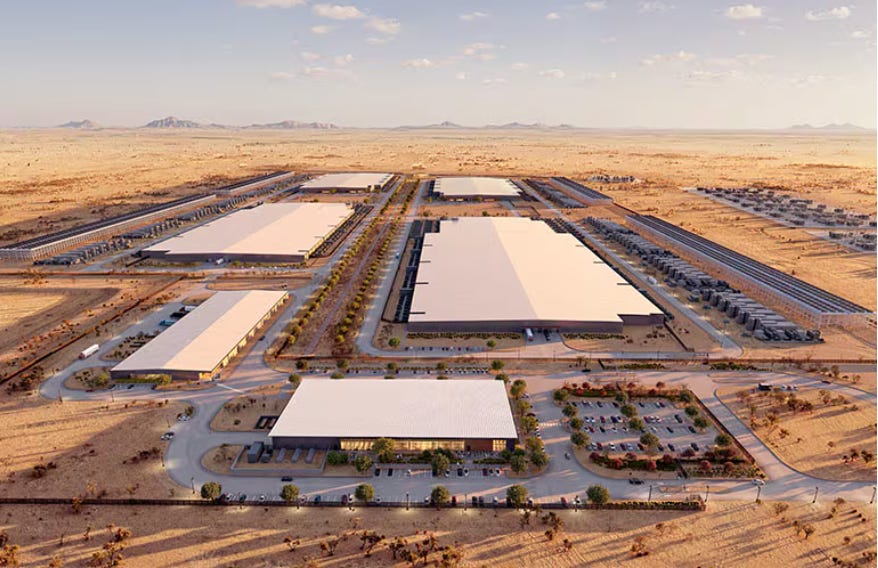
The developer is a unit of Blue Owl Capital. The notice is about power: the project’s natural gas supply has been tangled up in permit denials. According to the Wall Street Journal, Oracle’s lease is “hell-or-high-water”: it can’t be terminated, and Oracle must pay rent whether or not the campus has power. The force majeure provision can delay the start of full rent payments by up to three years, after which the lease extends automatically.
Oracle’s shares fell more than 3% that day. Blue Owl’s shares also declined. And the $18 billion of construction debt behind the project was already being quoted below 90 cents on the dollar.
Both companies moved quickly to calm things down. Oracle said force majeure notices are “commonplace in developments of this scale.” Blue Owl said the notice “does not change the financial commitments” to the project.

The Financial Times reported a key detail: even if rent is delayed, Oracle still owes a “carry cost” that covers interest to the lenders and a set return to Blue Owl’s equity. The WSJ described it differently: Blue Owl’s roughly 9% return during construction comes out of the money raised to build the project, and the financing set aside funds for up to three years of delays before lease payments begin.
Oracle, of course, is not the borrower [insert shocked Pikachu emoji]
The $18 billion construction loan sits with four companies called Red Chiles (there are Green Chiles in this story, too. Keep reading). The power plant’s financing sits somewhere else. The equity sits somewhere else again. And some of those pieces ended up in funds that individual investors can buy.
So who actually owns the risk?
I don’t have a dog in this fight. Build all the data centers you want, and if you want to invest in AI, more power to you (pun very much intended). I would actually like this project to succeed: at the moment, I slightly prefer Claude, but heck, Anthropic needs strong competition.
I was curious, and wanted to see what I could find. And find, I did.
How I went looking
I won’t be the first to tell you that data-center financing is complicated. These projects sit at the intersection of real estate, massive capex and hype. And your girl is a sucker for punishment. In other words, we are a match made in heaven.
I started where any reasonable person would: searching disclosed fund holdings for “Project Jupiter” and “Oracle.” That gave me a big fat zero relevant results, plus two unrelated deals that happened to share the codename. (Apparently every dealmaker’s favorite planet is Jupiter).
Now, remember, aside from imaginary things (future demand and pro-forma revenues) the project involves a very real tract of land. And land, of all things, gets recorded at the county. So I went to the Doña Ana County Clerk’s records and found Ordinance 367-2025, recorded September 22, 2025, as instrument #2520581.
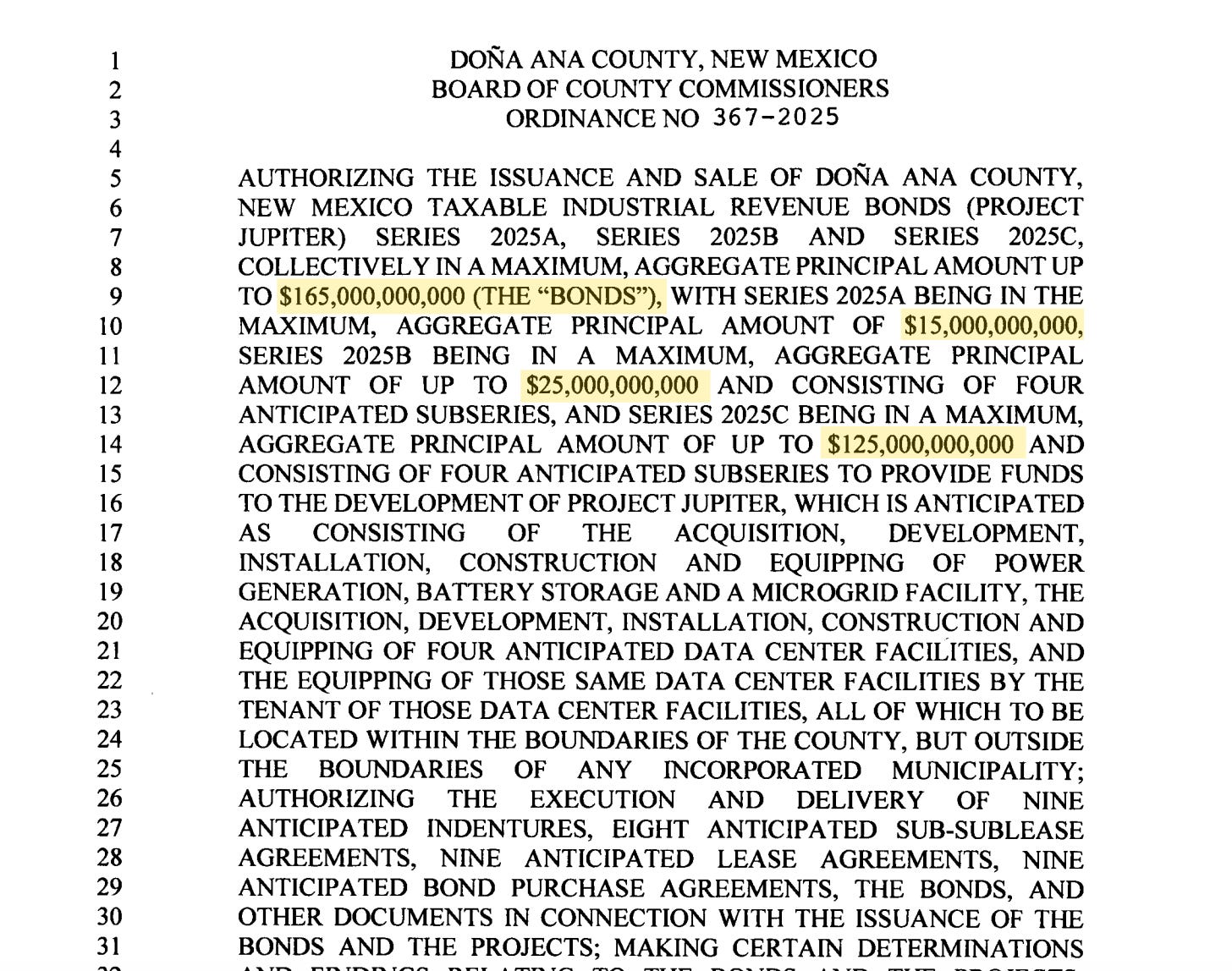
The document was a goldmine of entity names:
Yucca Growth Infrastructure, LLC.
Red Chiles A, B, C and D, LLC.
Green Chile Ventures LLC.
None of them say “Oracle,” “Blue Owl” or “Jupiter” on the tin, which explains why my first search found nothing.
I then traced those names through state business registries and SEC filings, with much better results.
Today I’ll tell you the story of this project. It’s incomplete, and I’ll tell you why. But I’ll show you what I found and exactly where I found it.
Three numbers that aren’t the same number
Let’s go through the numbers. We’ll start with the headline: a $165 billion data center (NYT likened it to “the fever dream of a modern pharaoh”). That number comes from the bond ordinance, and it isn’t $165 billion of financing.
It’s a ceiling on industrial revenue bonds, a standard New Mexico tax-incentive tool. The county takes title to the property, which takes it off the property-tax rolls, and leases it back to the developers for 30 years.
The county gets payments in lieu of taxes: $360 million over 30 years, or $12 million a year.
So the $165 billion is a tax structure. The ordinance splits it three ways: up to $15 billion for Yucca (power), $25 billion for Red Chiles (the buildings) and $125 billion for Green Chile (the tenant's equipment), and each series is bought by the company's own affiliate.
The actual project financing is much smaller:
About $18 billion of construction debt, from more than 20 banks, priced at SOFR plus 2.5% (FT).
About $3 billion of Blue Owl equity, according to Reuters.
Follow the names
Now we are going to play Hansel and Gretel (I play the part of Gretel, not the Witch). We are going to use the LLC name breadcrumbs to find our way. And yes, I'm deliberately using breadcrumbs, not pebbles. I'll tell you why at the end.
Start with the oldest. BorderPlex Manager, LLC was formed in Delaware on November 15, 2024: