


For many retail investors, the gateway to the promised land of private credit has been hard money funds. These are vehicles that lend against the value of residential real estate (often "fix-and-flip" or small commercial projects), to borrowers who either don't meet conventional lending criteria or need a fast close1.
Private credit is a catch-all phrase that includes virtually all non-bank lending. Real estate private credit is one of the buckets, with its own unique wrinkles:

The vast majority of such funds file a Regulation D form, which exempts them from filing financials with the SEC and makes them totally opaque.
For a while, I wanted to do a case study on one. I just didn’t have a good candidate. Well, folks, I finally found one.
Bonus: the fund is new (less than a year old), which makes the financial statements somewhat easy to decipher (ok, ok… they are never easy, this set happens to be a little less convoluted than others).
Here’s another real estate debt case study, also full of interesting things:

Disclosure: This case study is provided for educational and informational purposes only and should not be construed as investment, legal, tax, or financial advice. The views expressed are solely those of the author. All examples are illustrative in nature and not guarantees of future outcomes. Readers should conduct their own independent research and consult with qualified professionals before making any investment or financial decisions.
What’s in the fund
First Eagle Real Estate Debt Fund is managed by First Eagle Investment Management and sub-advised by Napier Park Global Capital. It launched on March 31, 2025, and is structured as a closed-end interval fund that has elected REIT status.
It makes short-term bridge loans (typically 12 to 36 months) to residential rehab borrowers, and has recently added land-banking deals (financing lot development for homebuilders) and a sleeve of residential mortgage-backed securities.
As of December 31, 2025, the fund had $50.3 million in net assets across 70 positions. So, what can we learn from the financial statements? Quite a bit.
1. Start with the balance sheet
“Why do we start with the balance sheet, Leyla?” Because it’s the first statement in the annual report.
(In this case, you only have to flip through 16 pages to get there.)
And because reading financial statements is hard enough as is, so we’ll choose the path of least resistance.
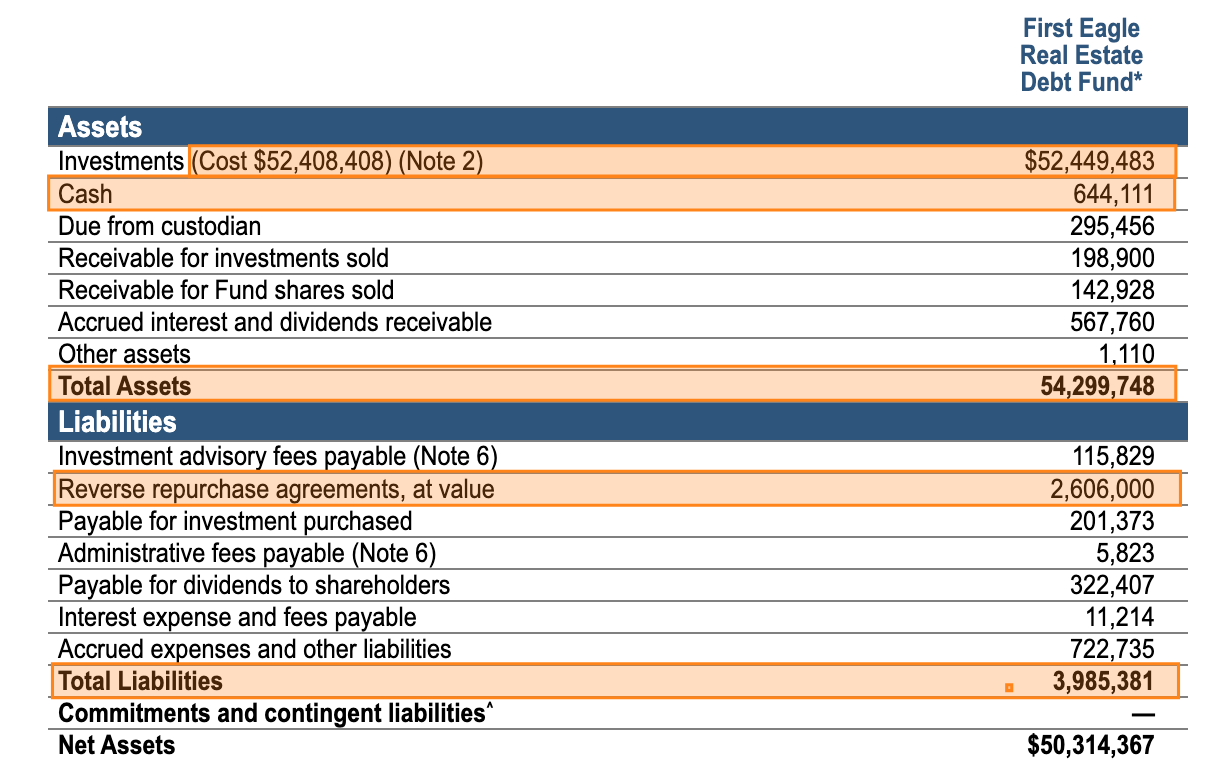
A few things jump out:
1. Cost and value of investments
The fund held $52,408,408 of investments at cost and $52,449,483 at fair value (are your eyes bleeding yet?) The gap is only $41,075 in net unrealized appreciation (it’s from the RMBS sleeve, not the loans).
The loans are short-term, with a weighted-average term of 13.7 months, and are carried at par. Which brings us to a very important point for investors: