


Private equity firms now control nearly $1.4 trillion in insurance company assets. But when most people talk about the risks, the conversation stops at “private credit” and “private letter ratings”, which barely scratch the surface of what’s actually on these balance sheets.
In today’s guest post Rod Dubitsky, who writes investigative research on insurance, structured credit, and private equity, provides a roadmap to the private asset categories that end up on insurance balance sheets, why they’re there, and what the labels actually mean. If you’ve followed the private credit and insurance conversation and found the terminology confusing, this is your field guide.
-Leyla
Overview
Out of the ashes of the Savings and Loan crisis a book was published with the title – The Best Way to Rob a Bank is to Own One, by the great chronicler of the S&L crisis, William Black. I think the same can be said about today’s insurance industry.
I have published many articles focusing on insurance and the Private Equity (PE)/ Private Credit (PC) ecosystem. Those articles focused on specific insurers and/or asset types.

The goal of this article is to demystify the many ways insurance companies are exposed to the PE/PC ecosystem and to describe the growing influence of private asset managers over the insurance industry.
There are many risky asset types that insurance companies invest in. This is not new. What is new is the more aggressive push to invest in illiquid private assets originated by an affiliated PE/PC sponsor. The investment categories are many and often in the public discourse are incorrectly defined and / or conflated.
This article provides an overview of 2 trends:
1) PE ownership of insurance companies, and
2) Insurance companies increasingly investing in Private Assets.
These trends are inextricably linked. The primary goal of PE/PC and insurance tie ups are the ability to use insurance company balance sheets to absorb PE/PC originated assets, increase Assets Under Management (AUM) and perpetuate the fee generation machine.
I first focus on the broader trends and then dive into specific asset categories and risks that PE linked insurance companies are exposed to. This article doesn’t cover all risky asset classes, but rather those most connected to PE/PC sponsors. Asset classes like Commercial Mortgage-Backed Securities (CMBS) and Commercial Real Estate Mortgages, merit attention but are beyond the scope of this article.
As an example of the latter, Apollo dissolved their Commercial Mortgage REIT and “sold” $9B of its commercial mortgages to Athene at a price near 100, when the REIT was trading at a deep discount to NAV. To me, this raised questions about whether Apollo was using its insurance balance sheet to support an affiliated vehicle. This illustrates the fact that PE/PC sponsors can influence the assets of their captive insurer far beyond the private assets label.
How and why Private Asset sponsors control insurance companies
Before jumping in, it’s important to understand the flow from the PE/PC sponsor to the insurance companies. Apollo was among the first to invest in, control and scale an insurance company (Athene).
The first goal is for the sponsor to control the investment decisions at the insurance company. This can be achieved in several ways. Most straight forward is for the PE/PC sponsor to own the insurance company. Once they own the insurance company, the control is complete. Once owned, the PE/PC sponsor can appoint themselves as the Investment Manager (IM) for the insurance company. This role is generally formalized under an Investment Manager Agreement or IMA.
A PE/PC sponsor doesn’t need to have complete ownership to benefit from the above relationship. Ownership levels run the gamut from 0 to 100%. The key is to be appointed Investment Manager. Ownership gives more control, but even absent ownership, the PE/PC role as IM can achieve some of the same goals and presents similar risks.
See below for the basic flow of the relationship.
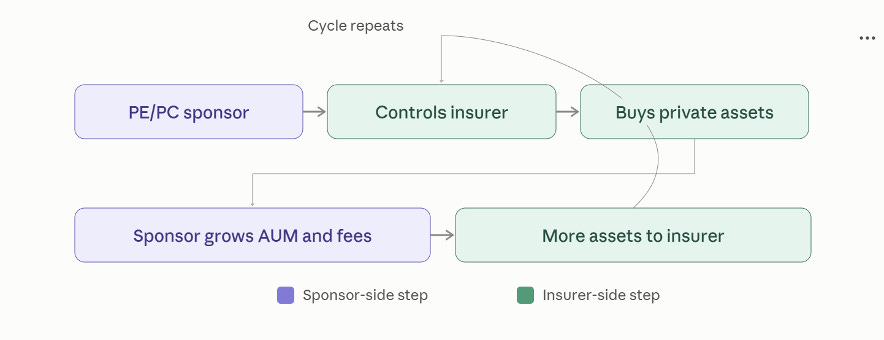
Private asset sponsors want control of insurance companies for 5 reasons: 1) the holy grail of permanent capital, 2) efficient leverage, 3) ability to commit a large balance sheet for deals that wouldn’t be possible with a traditional fund structure, 4) ability to grow Assets Under Management and therefore fees, 5) weak regulatory oversight.
Trends in Private Assets and insurance
As noted above, two trends are occurring in parallel. Growing control of insurance balance sheets by private equity or private credit sponsors and insurance companies increasingly investing in private assets.
The chart below (source: McKinsey) illustrates the explosive growth in private capital-controlled insurance companies. While McKinsey doesn’t identify the specific insurers, it’s likely that Apollo, KKR and Brookfield alone comprise 50% of the assets. Notably, I don’t believe McKinsey includes MassMutual since they own the asset manager, rather than Vice Versa (Barings) and it’s likely they wouldn’t consider Barings as a private asset manager. Adding MassMutual alone would bring the total close to $2T.
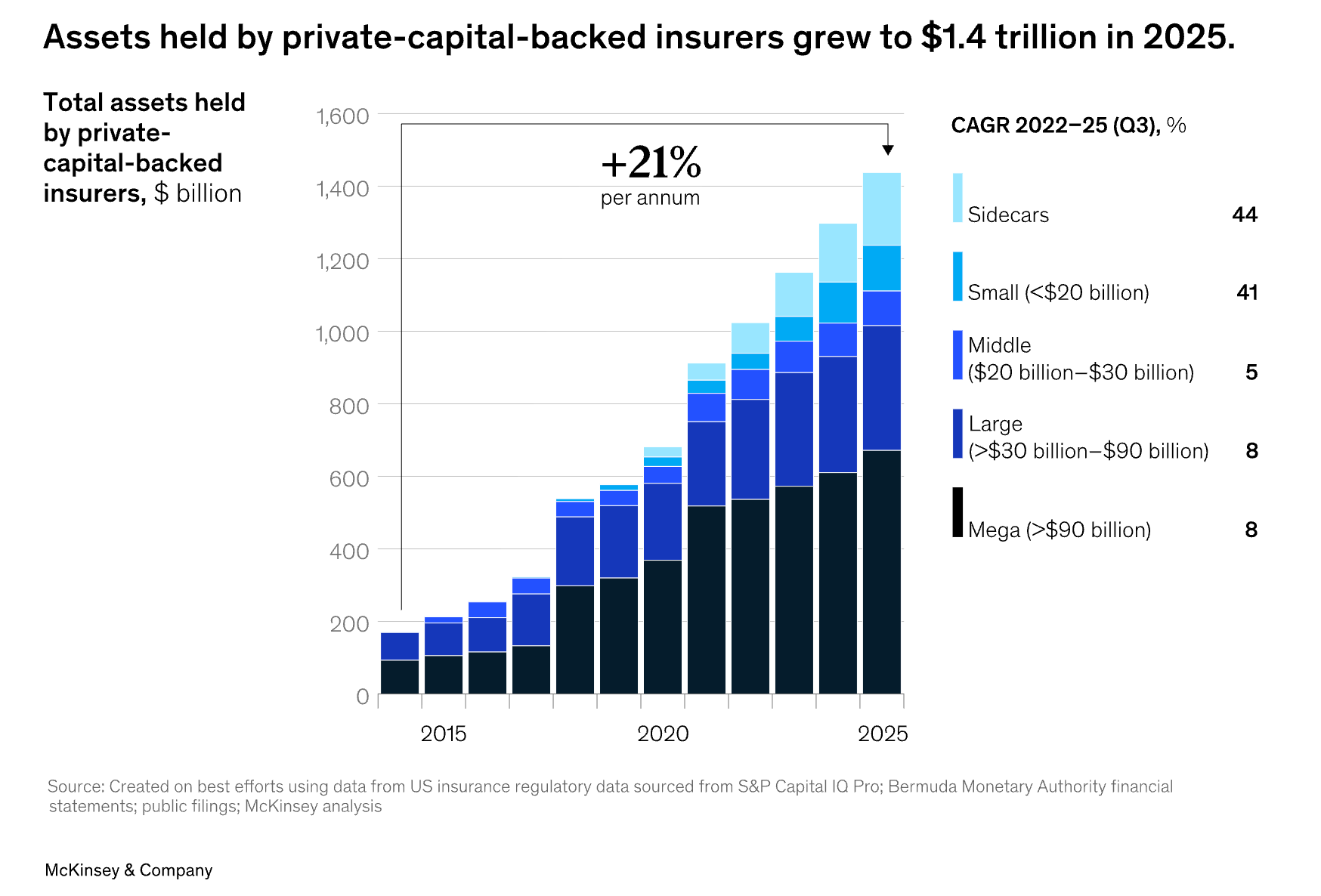
Turning to the specific assets, the chart below shows that the increase in private placements held by insurance companies closely tracks the growth shown in the above chart. It’s important to note that private placements are not the same as Private Letter Ratings (PLR) - a topic that has gained a lot of attention. While private placements often have private letter ratings, they can also have public ratings. Therefore, the categories are related, but not the same.
A late 2025 Fitch report revealed that PE affiliate insurers have 6X the exposure to private assets (as a percentage of asset) relative to non-PE affiliate insurers.[1]