


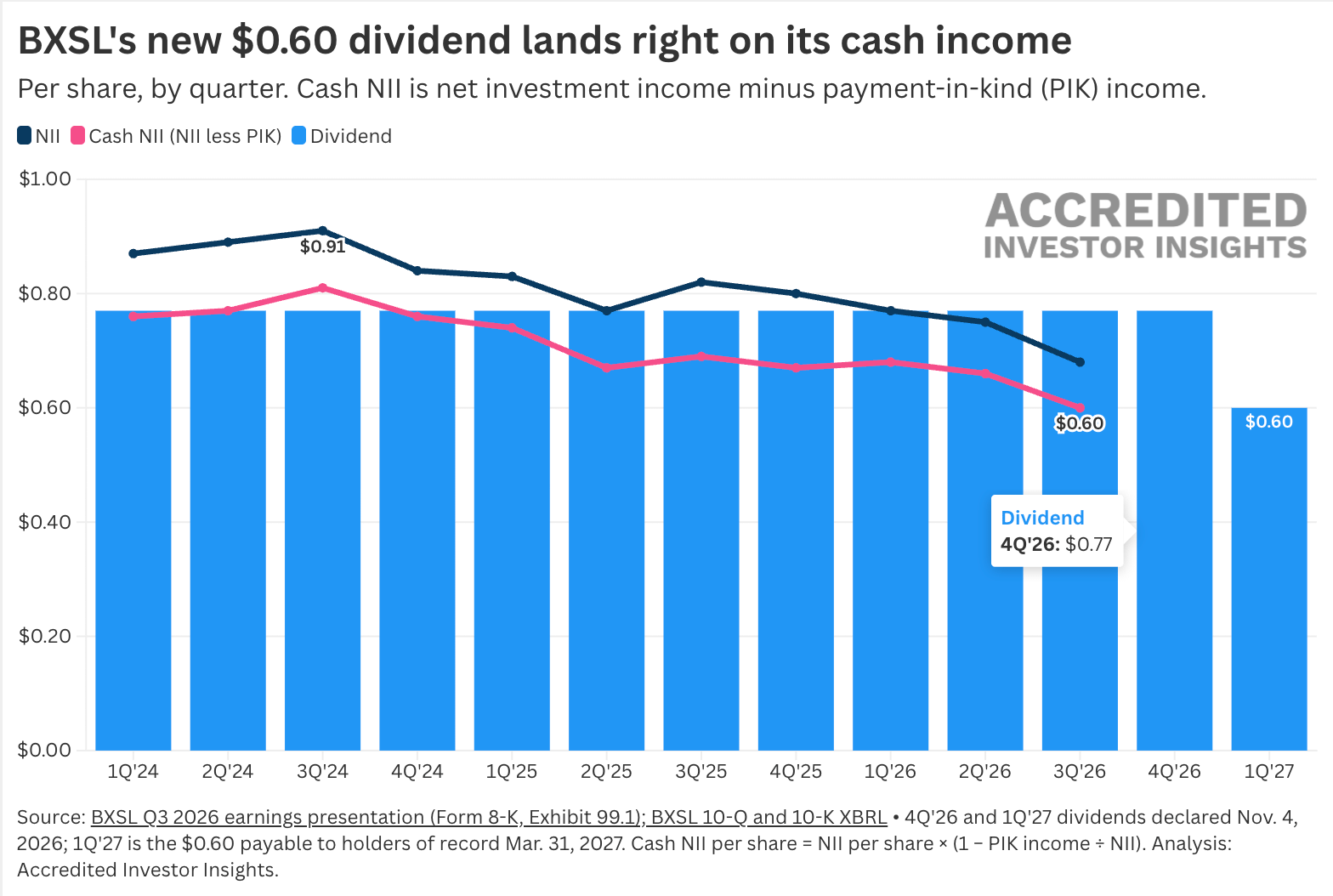
On November 4, Blackstone Secured Lending (BXSL) declared a $0.60 dividend for March 2027. That’s a 22% cut from the $0.77 it has paid every quarter for three years. (It will pay one more $0.77 for Q4)
The following number wasn’t reported, but is easy enough to calculate: $0.60 is almost exactly BXSL’s third-quarter net investment income excluding PIK.
Now the sister fund. Blackstone Private Credit Fund (BCRED) owns nearly the same loans: 97% of BXSL's portfolio is in borrowers BCRED also holds. BCRED cut dividends first, from $0.22 to $0.20 a month on Class I shares in late 2025. Even so, it covered only 79% of its payout in cash in the second quarter. It hasn't covered it fully in cash in any quarter since the start of 2024.
If you're new to BCRED, start here:


BCRED is due to report its Q3 results in about a week, but we can dust off our crystal ball (and a calculator) and figure out where things are going to land.
Before we do that, a quick detour into cash net investment income. It’s a number every BDC investor should know how to calculate, and I promise the math is easy (famous last words).
How to calculate cash NII (and why you should)
Net investment income (NII) is what a BDC says it earned. Not all of that income arrives in cash: some borrowers pay in cash, others pay in IOUs, adding interest to their outstanding loan balances. That’s your PIK (or payment-in-kind), which we’ve discussed ad nauseam in previous episodes.
Which brings us to cash NII. The good news is that the math is so simple, your cat can probably do it (I say this as a dog person):
Cash NII = Net investment income − PIK income
Cash coverage = Cash NII ÷ Distributions declared
Both numbers are generally easy to find in a BDC’s 10-Q:
Net investment income: the after-tax NII line on the statement of operations (aka income statement). (CTRL+F is your friend)
PIK income: go to the schedule of investments, add up every PIK line, both interest and dividends, for all 332 (or however many) positions.
I’m just kidding (before you go and start throwing objects at your computer screen). Most BDCs and interval funds report PIK as a separate line on the income statement. Looks like this:
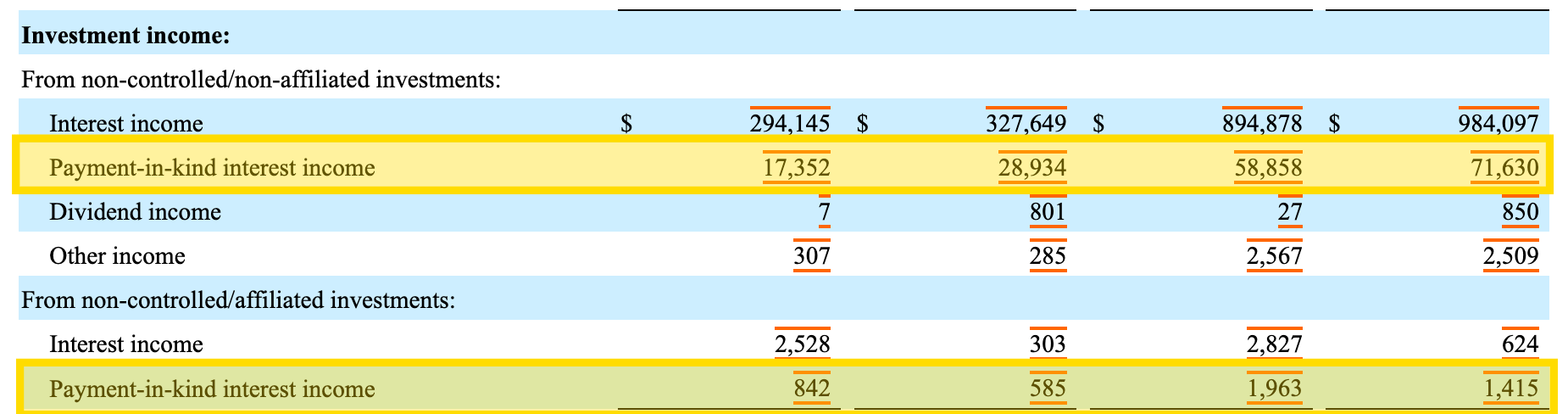
Every once in a while, you’ll run into a fund that doesn’t report it on the income statement. Goldman Sachs Private Credit Corp is one. Its PIK is buried in “interest income.” When that happens, go to the cash flow statement and look for “payment-in-kind interest”, or “PIK”, --you get the idea.
One catch: cash flow statements show year-to-date figures, so subtract the same line from the previous 10-Q to get the quarter:

Finally, divide by distributions declared for the same quarter, in dollars. For funds with several share classes, use fund totals.
For example, BXSL Q3:
$158.1 million of NII minus $18.2 million of PIK = $139.9 million of cash NII, or $0.60 a share on 232.9 million shares. Reported coverage: 88%. Cash coverage: 78%.
▻ Reported coverage tells you whether the dividend is covered by accounting earnings.
▻ Cash coverage tells you how much is covered without relying on PIK.
Neither is a perfect measure of cash generation.
‼️ Some nuances to keep in mind:
Some PIK is eventually collected, when a loan is repaid or refinanced. And, if we wanted to nitpick, cash NII still contains other non-cash accounting items, such as discount accretion.
But if you rely on a fund for income, this is one of the first calculations I’d make.
Now, back to Blackstone.
🔒 Coming up for paid subscribers: what BCRED would pay on BXSL’s new yardstick, the three loans BXSL just put on non-accrual (BCRED holds nearly five times as much), and what happens if redemptions don’t slow down.