


I was going through Nvidia’s latest 10-Q (as one does before bed), and at some point I realized it looked awfully like a fund’s financials.
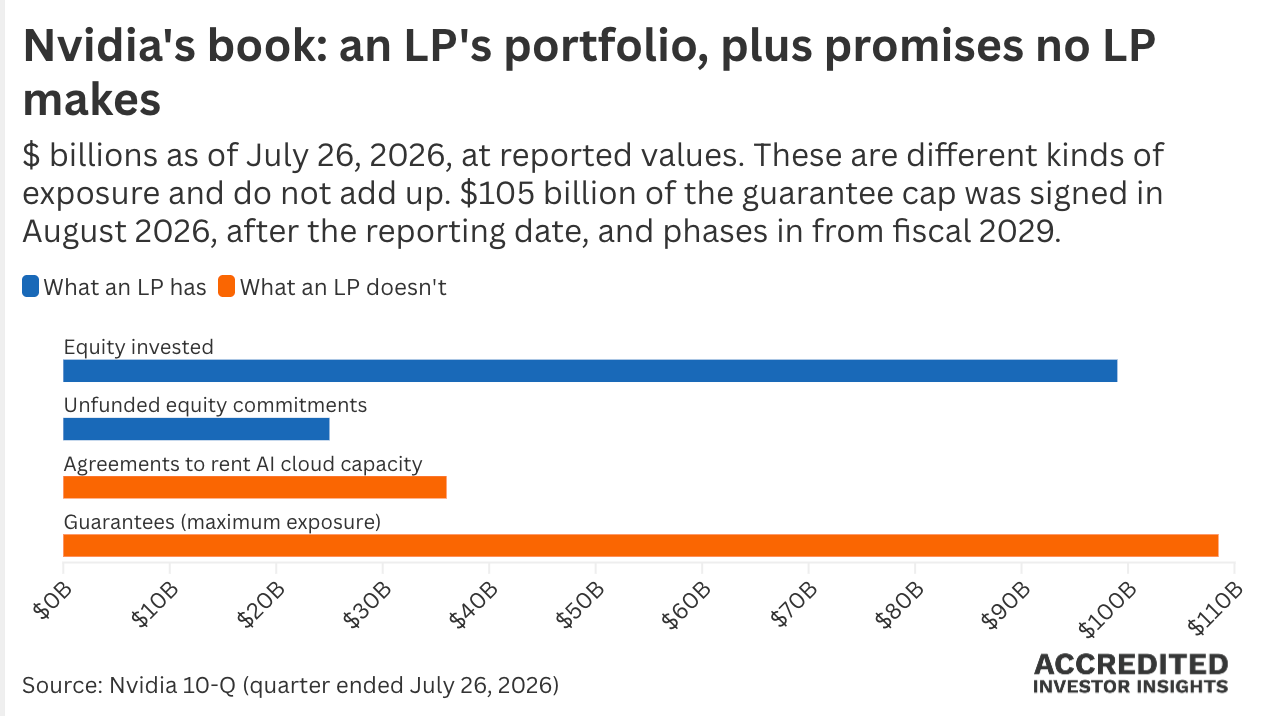
$99 billion in equity investments. Another $25 billion in unfunded commitments. $9.1 billion of cumulative unrealized gains on its private holdings.
Of course, Nvidia isn’t your typical limited partner (LP).
It sells its portfolio companies the chips they run on. It has agreed to rent $36 billion of computing capacity from AI clouds. It has committed $1 billion of convertible loans to one of them. And it has guaranteed up to $108.5 billion of its customers’ rent and power bills.
This is a super-charged LP that invests in the company, sells it its main input, rents its output and co-signs its lease ♻️
On Thursday, Jensen Huang, the CEO who built that book, resigned.
Nvidia is increasingly putting its balance sheet behind its own customers. And the AI debt sitting in investment funds may be less diversified than it looks: different borrowers, different financing vehicles, but overlapping tenants, suppliers and sources of credit support.


Let me show you how I got there.
Five roles, one company
A normal LP writes a check and waits. (… and waits.)
Nvidia does five things: