


In April 1987, Mellon Bank (founded in 1869 by a retired judge Thomas Mellon and his sons) reported its first loss in its 118-year history. That first quarterly loss was $60 million, and it was only the beginning.
Mellon had spent the late 1970s and early 1980s lending into the oil patch, and into real estate ventures in Texas, Louisiana and Colorado that oil money had inflated (among other lending decisions that would come to haunt them). When energy prices collapsed, the loans blew up. By the end of 1987, Mellon had booked a record loss of $844 million.
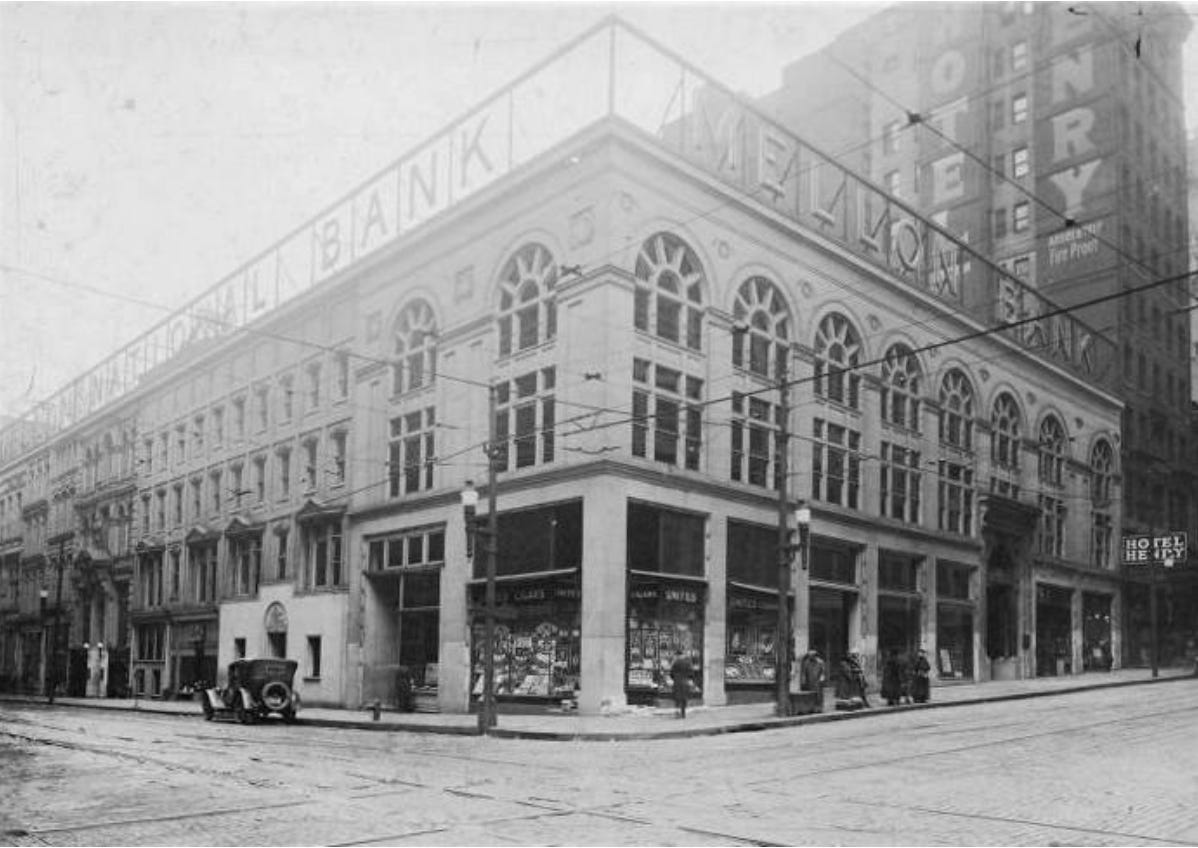
The board went looking for outside help and brought in Frank Cahouet, a former Fannie Mae president who had run Crocker National in San Francisco. He arrived in June 1987 and promptly cut about 3,000 jobs. Then he proposed moving the bad loans out of the bank entirely, a structure now widely cited as the first good bank/bad bank split.
The Mechanics of the Split
A new entity, Grant Street National Bank, was set up for one purpose: working through the bad loans. In mid-1988 Mellon announced it would move about $1 billion of its $1.6 billion in bad loans into it, financed partly with junk bonds sold by Drexel Burnham Lambert. The Federal Reserve was skeptical of chartering a bank whose only job was to die, but approved the applications on September 29, 1988.
Grant Street had its own board, its own staff and one mission: recover what it could and liquidate. It bought the loans at a steep discount, about 57% of face value by the commonly cited account, so Mellon took the haircut up front.
In July 1995 Grant Street paid its last proceeds to bondholders and liquidated. Mellon, freed of the drag of non-performing assets, reinvented itself as a money manager and eventually became half of BNY Mellon.
The end.
Leyla, why TF the heck are you telling us about a bank?
Because I love a good banking story, ofc. Aside from my love of banks and good stories, there is a VERY IMPORTANT POINT, so pay attention. What I’m about to describe is a solution we’ll see more of, according to my crystal ball.
To be perfectly frank with y’all, a hedge fund side pocket is the better analogy (more on that below). But I like banks better than hedge funds, so the banks go first.
Fast-forward 38 years. The same structural idea has migrated from commercial banking into private equity, minus the price discovery.
Disclosure: This article is provided for educational and informational purposes only and should not be construed as investment, legal, tax, or financial advice. It is based on publicly available information, including Partners Group’s press releases and published media reports, as of October 9, 2026. The proposed restructuring of Partners Group Global Value SICAV is subject to shareholder approval, and its final terms have not been made public; details described here, including the reported allocation between sub-portfolios and redemption limits, may differ from the terms ultimately adopted. References to “bad banks,” “side pockets,” and academic research are analogies and frameworks for analysis, not claims about Partners Group’s intentions, conduct, or the future performance of any fund. The views expressed are solely those of the author. The author holds no position in Partners Group or its funds. Readers should conduct their own independent research and consult qualified professionals before making any investment decision.
Meanwhile, in Switzerland
The setting is different. Mellon held a distressed loan book in a banking crisis; Partners Group runs an evergreen fund facing elevated redemptions. What’s similar is the fix: split the old from the new, and release each into the wild.
On June 3, 2026, Partners Group notified investors in its flagship Luxembourg evergreen vehicle, Partners Group Global Value SICAV, that it would cap quarterly redemptions at 5% of Net Asset Value (NAV). Redemption requests had hit ~9.8% of NAV for the second quarter (most of the requests came from investors in Asia and Australia).
The next day, the firm said redemption pressure that started in private credit had spilled over into private equity. It flagged a second, Delaware-domiciled evergreen vehicle where tender requests were running at about 6% of NAV, above its 5% offer. The firm didn’t name it, but the description fits the Partners Group Private Equity (Master Fund), which I wrote about the same week:

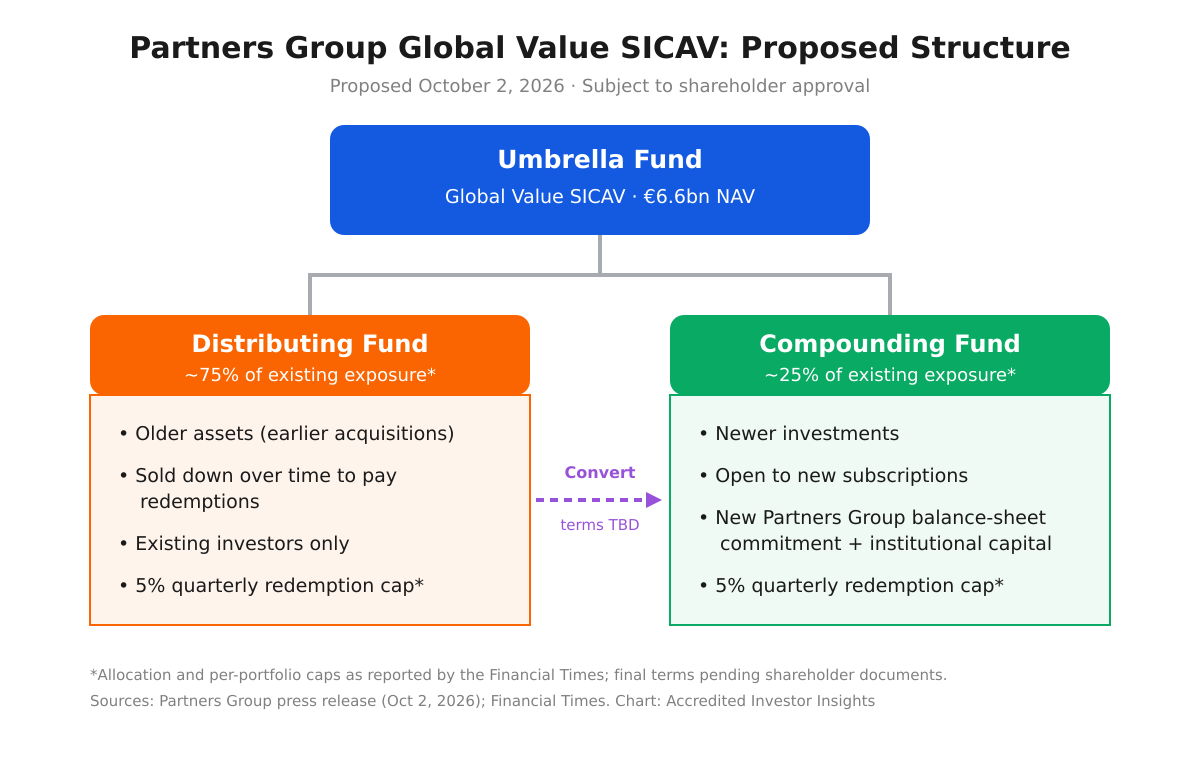
On October 2, 2026, Partners Group presented its structural fix. Subject to a shareholder vote, the €6.6 billion SICAV would be reorganized into a Luxembourg umbrella structure containing two separate sub-portfolios, split by when the assets were acquired:
Distributing Fund: the legacy, older assets, which will be realized and sold down over time to meet redemption requests.
Compounding Fund: holds the newer investments, open to fresh subscription inflows, backed by an additional balance-sheet commitment from Partners Group alongside new institutional capital.
The Financial Times reports that existing investors would see roughly 75% of their exposure land in the Distributing Fund and 25% in the Compounding Fund, each with its own 5% quarterly cap. The FT’s source described the older assets as the weaker performers.
Partners Group frames the move as setting the strategy up to keep compounding returns. Nobody is using the words “bad bank.” Yet the architecture is unmistakable.
A “Bad Bank” Without a Market Price
The motive behind Partners Group’s restructuring isn’t all that different from Mellon’s in 1988: wall off the legacy book so the clean vehicle can raise new money. That’s the good bank’s whole reason to exist, and Partners Group says the Compounding Fund has already drawn interest from new institutional investors.
This structure, however is materially different from the good bank/bad bank split in several ways: