


I’ve always liked word math problems.
(No idea why I decided to pursue a degree in English my first go-around in college, but that’s beside the point. I came to my senses later in life, when faced with the prospect of living in abject poverty surrounded by books.)
Enough about college majors, back to math problems.
MATH PROBLEM OF THE DAY
TCP owns a $1.29 billion portfolio.
On August 4, 2026, it sells 95% of a vehicle holding $523 million of loans (~roughly 48% of its debt portfolio) to Pantheon Ventures (Bloomberg, WSJ)
The loans are sold at roughly a 5% discount to fair value.
Question: How does that transaction reduce TCP’s NAV by $57 million, or 10.4%?
Show your work.
(The stock rallied 11% on the news, but that’s a separate story.)
👉 I kid you not, today’s math problem was solved by reading the footnotes to appendixes. So read the dang financial statements (and footnotes, and appendixes, and exhibit 99.1, while you are at it)

To solve today’s math problem, we first need to identify what exactly was sold. And no, “loans” is not the right answer.
Step 1: CLO
On May 27, 2026, TCP took $535.8 million of loans on its books (TCP’s assets, not the borrowings of the fund) and packaged them into a securitization (a CLO):
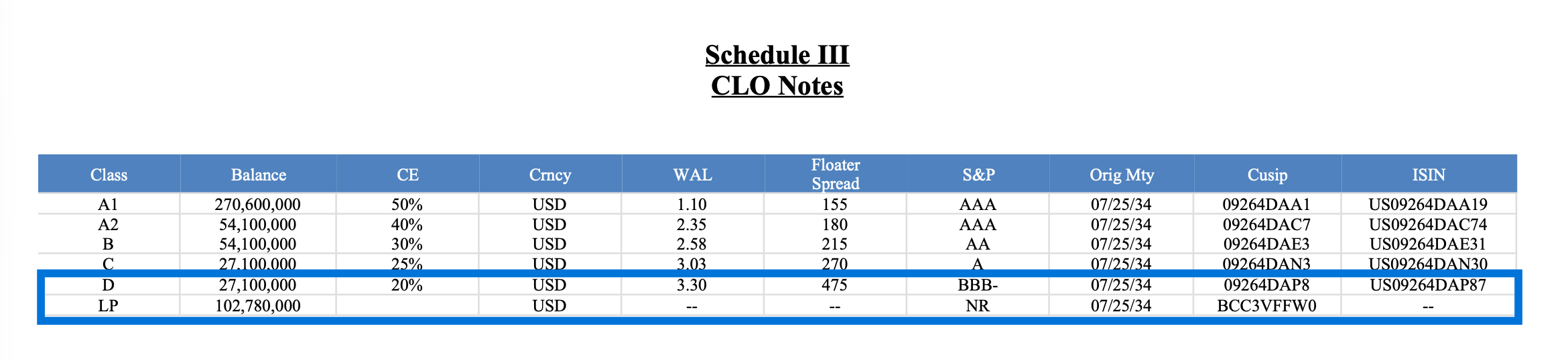
TCP sold the senior, investment-grade-style slices of the pool to outside CLO debt investors, raising $405.9 million.
It kept Class D tranche, and the bottom slice (the “equity” or first-loss piece) for itself.
That retained slice was worth roughly $130 million at par, against a $536 million pool.
For those not yet sufficiently caffeinated to do the math, that’s about 3x debt-to-equity leverage on that specific slice of the portfolio, layered inside a fund that was already carrying its own leverage (1.38x net debt-to-equity) at the company level.

None of this is unusual, I’m simply showing you the plumbing inside. TCP owned and consolidated the entire structure on its own balance sheet for about ten weeks before announcing the Pantheon transaction.
The first case study on this fund:

Step 2: What got sold to Pantheon and at what price
By June 30, 2026, the loan pool inside this structure (plus some additional contributed positions) was marked at $523 million. We know there is $406 million of CLO debt sitting on top of it. Add the roughly $74 million TCP separately posted to cash-collateralize the vehicle's unfunded commitments, and TCP's total equity claim comes to: