


Gates.
The dirty word in the world of semi-liquid funds.
Nobody notices them when things go well, but when things go south, investors view gates as a lifeboat with a wait list.
Today we’ll talk about:
what gating provisions are,
how they work across different fund structures,
and where to find them in the documents you signed.
We’ll use two real-world examples, Blue Owl’s OBDC II and Blackstone’s BREIT, to show how gates play out in practice, and why the language around “liquidity” can mean very different things depending on who’s talking.
Let’s start with the freshest example.
You’ve seen the headlines. You may have also seen Blue Owl’s statement (emphasis mine):
“Contrary to what has been reported, we are not halting investor liquidity in OBDC II. In fact, we are accelerating the return of capital.”
And that may have left you hooting scratching your head.
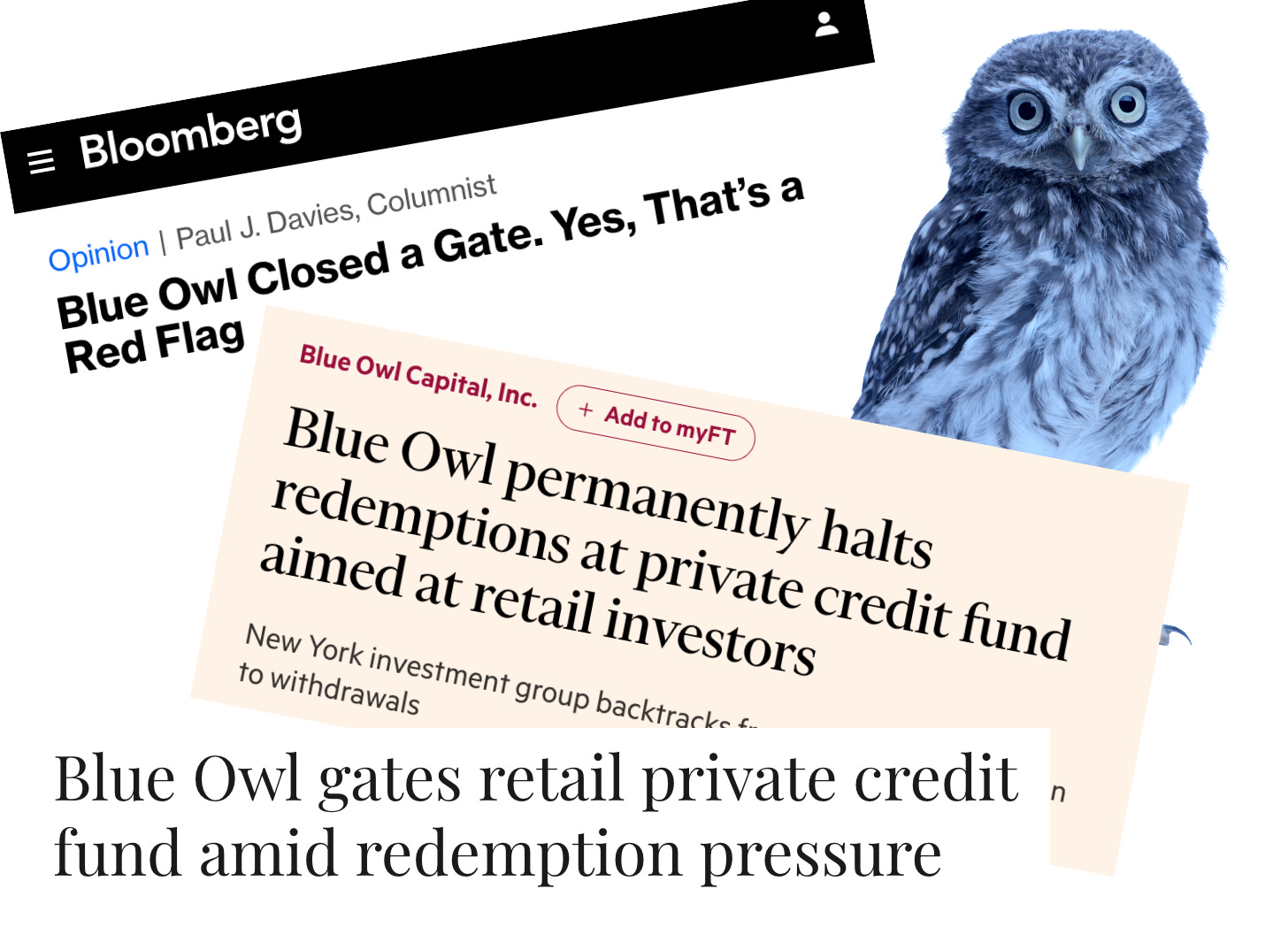
Some headlines were correct. Redemptions were halted. But liquidity was not.
Those are not the same thing. Let me explain.
OBDC II is a closed-end, finite-life fund: it stopped selling shares back in April 2021. The plan was to provide a liquidity event to investors 3–4 years after that date (via merger, IPO, or asset sale).

During the life of the fund, the manager utilized quarterly tender offers: each quarter, they would offer to repurchase up to 5% of the fund’s outstanding NAV from shareholders. As long as aggregate demand didn’t exceed 5% of NAV.
From the fund manager’s standpoint: they liquidated 5% of the fund’s NAV quarterly.
From the investor’s standpoint: you liquidated 100% of your position.
The change announced on February 18 means the fund will no longer offer to repurchase your shares through quarterly tender offers. Instead, the fund sold $600 million of direct lending investments at 99.7% of fair value and will return approximately 30% of investors’ capital to all shareholders on a pro rata basis, within 45 days.
From LP standpoint: you get 30% of your money back, whether you asked for it or not.
From the fund’s standpoint: they liquidated 30% of the fund’s NAV (six times the size of the 5% quarterly tender offer they replaced).
Blue Owl’s framing is worth reading carefully. They’re not wrong: “Instead of resuming a 5% quarterly tender — under which only tendering investors would receive a partial return of capital — we are distributing an amount six times greater and returning capital to all shareholders.”
That is, mechanically, accurate.
But let’s also be precise about what changed. Under the old structure, an investor who wanted full liquidity could get it (100% of their position) as long as aggregate demand didn’t exceed 5% of NAV.
Under the new structure, every investor gets 30%, but no investor can choose to get 100%. The door is wider, but you no longer get to decide how far you walk through it.

When do you get the rest? Blue Owl says the Board “intends to prioritize quarterly return of capital distributions going forward”. Note there is no timeline.
And OBDC II is hardly the only example. Remember BREIT? In late 2022, Blackstone’s $69 billion non-traded REIT hit its redemption limits, and gated the fund.
👉 Speaking of non-traded REITs. Here’s how valuation of assets works:

🔎 What IS a Gating Provision?
At its core, a gating provision is a contractual or regulatory mechanism that limits the amount of capital investors can withdraw from a fund during a specified period.
That’s it. That’s the concept.
They exist across virtually every private fund structure that provides periodic liquidity (from ’40 Act interval funds to Reg D evergreen vehicles), and they all serve the same fundamental purpose:
Protect the remaining investors from forced asset sales when too many people head for the exits at once.
When you, LP, wire money to a fund, you are handed a stack of documents you are supposed to read and sign. Somewhere in that stack (between the fee disclosures and the tax representations) is a warning about how illiquid your investment actually is.
👉 No post would be complete without me pounding you on the head about reading financial statements (and notes to said statements):

The fund can call itself evergreen, open-ended, whatever. Every prospectus will warn you: liquidity is conditional.
How conditional? That depends on the fund structure, regulatory framework, drafting of the governing documents. This is what we’ll talk about today.
Think of it this way: if the liquidity mechanism is the door, the gate determines
How many people can walk through it at once
Whether there’s a line
And under what conditions the door gets locked entirely
(And as with most exit doors, people tend to rush them at the same time.)
Gates come in several flavors (cue Coldplay’s “nooooobody said it was easyyy”🎶):