


Back in December we looked at the Cliffwater Enhanced Lending Fund (CELFX) and its rapid growth (not to be confused with CCLFX or CPEFX).
Six months of new filings are now in, so time for a vibe check an update on where the fund stands: how much capital came in, how the fund’s leverage picture changed, and what the earnings underneath the distributions actually look like.
Here’s the post from December (which feels like a lifetime ago)

Disclosure: This case study is provided for educational and informational purposes only and should not be construed as investment, legal, tax, or financial advice. The views expressed are solely those of the author. All examples are illustrative in nature and not guarantees of future outcomes. Readers should conduct their own independent research and consult with qualified professionals before making any investment or financial decisions. All figures below are from CELFX's SEC filings, in six-month increments ending each March 31 and September 30. Gain/loss figures are shown net and after-tax.
👉 No idea what an interval fund is? Lucky you (j/k)!
Start here:

And then read this:

What Hasn’t Changed
The Cliffwater Enhanced Lending Fund (CELFX) is a non-diversified, closed-end management investment company structured as an interval fund.
Not much has changed structurally. Roughly 72% of assets still sit inside various SPVs, with another 22% invested directly in senior secured loans. Functionally, it’s a fund-of-funds.
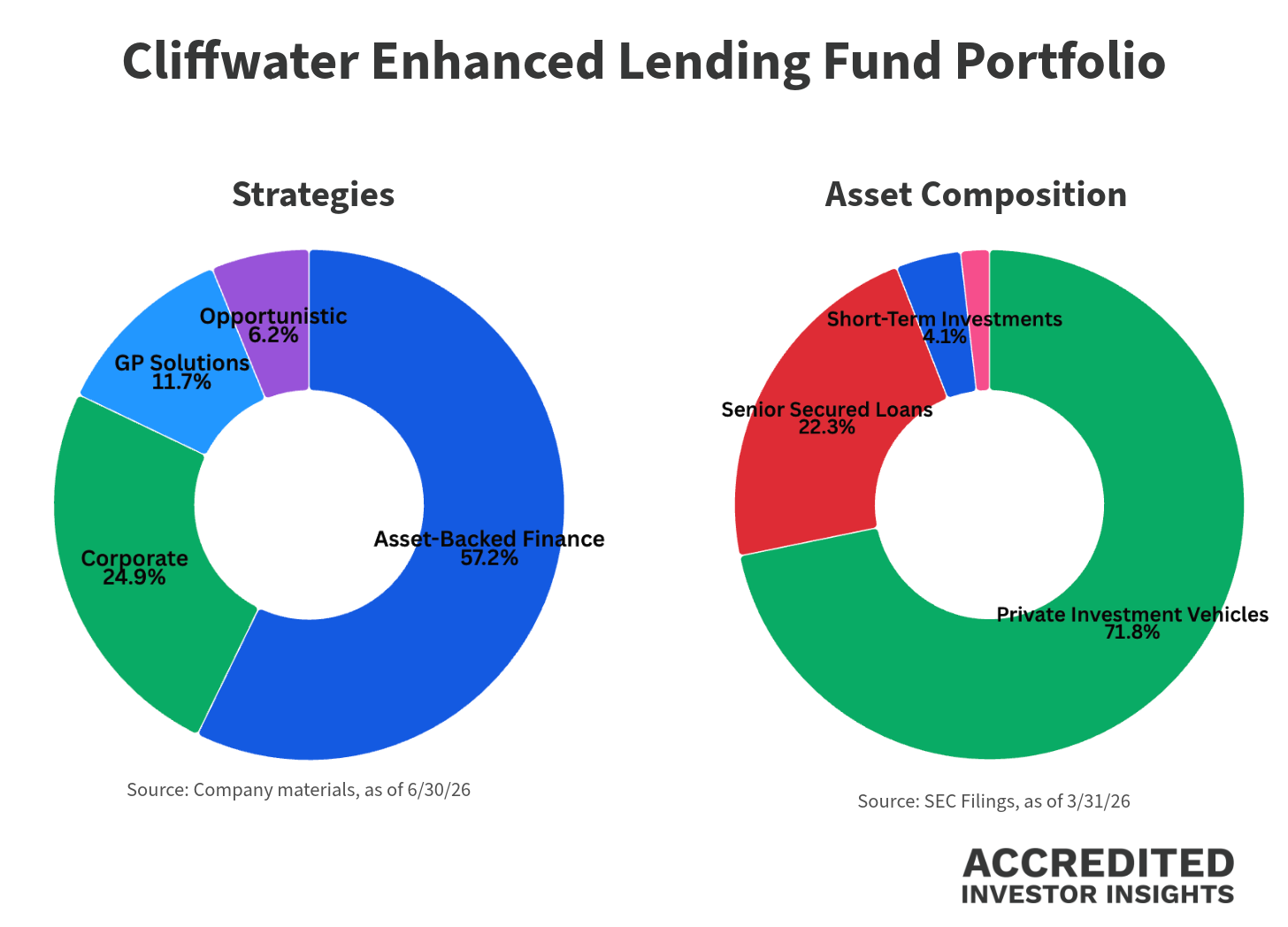
Something of note: many of the underlying funds are not registered under the 1940 Act (unlike CELFX itself), which has two implications:
They likely rely on Section 3(c)(1) (fewer than 100 beneficial owners) or Section 3(c)(7) (qualified purchasers only) exclusions. Translation: most mere mortals are not wealthy or connected enough to invest in them directly.
CELFX, meanwhile, dropped the accredited investor self-certification requirement in its latest prospectus supplement. Regulatory arbitrage, if you will.The underlying funds are not subject to the 1940 Act’s leverage limits. This means their borrowing is constrained only by LP agreements and lender appetite. More on leverage in a minute.

Assets Keep Growing
Net assets have grown in every reporting period. Most recently, from roughly $5.36B (3/31/25) to $7.82B a year later (~46% in twelve months), but the growth is slowing down:
Why is it slowing down?
Capital inflows are reversing, that’s why.

👉 Say it with me one more time:

Capital Flows
The growth is driven by new subscriptions, which (for now?) continue to run ahead of redemptions. Measured against net assets at the start of each period, sales have remained robust. That’s the good news.