


It should come as no surprise that U.S. commercial real estate is undergoing a reset.
The struggle is real across the board: from one-off syndicated deals to publicly listed REITs and everything in between. And while funds and REITs that own actual properties have some flexibility (you know, sell properties, raise additional capital, refinance), real estate fund-of-funds have a different problem.
They don’t control the assets underneath them.
We’ve seen this with Bluerock (BPRE):


Today, we're looking at another fund caught in the same pickle: Harrison Street Real Estate Fund (VCMIX).
But I’m less interested in enumerating all of VCMIX problems. The fund’s financial statements do a pretty good job of that themselves.
What’s more interesting is what happens next.
In May 2026, Nasdaq Fund Secondaries, LODAS Markets, and Harrison Street announced a collaboration to build a secondary-auction environment for interval-fund shares. Harrison Street said VCMIX would be the first manager to authorize transfers.
The development is interesting, and not just for VCMIX, but for the many other semi-liquid vehicles that are pro-rating redemptions. Remember, an interval fund has a mechanism for investors to get out (quarterly repurchase offers, at NAV), but it’s typically limited, and once the fund is pro-rating redemptions, there are few options for investors who want immediate liquidity.
And VCMIX’s repurchase history tells us there are plenty of investors who would like to leave:
The question is: at what price would someone else be willing to take their place?
That’s what we’re going to try to figure out.
Important disclosure. This case study is independent analysis published for educational purposes only and does not constitute investment advice, a recommendation, or a solicitation to buy or sell any security. All information is sourced from SEC filings (N-CSR and N-CSRS), the fund's prospectus, and publicly available company materials. Return estimates are hypothetical and for illustrative purposes only; they are not projections or guarantees. The author has no position in VCMIX and no business relationship with Harrison Street, Colliers, Nasdaq Fund Secondaries, or LODAS Markets.

The Fund
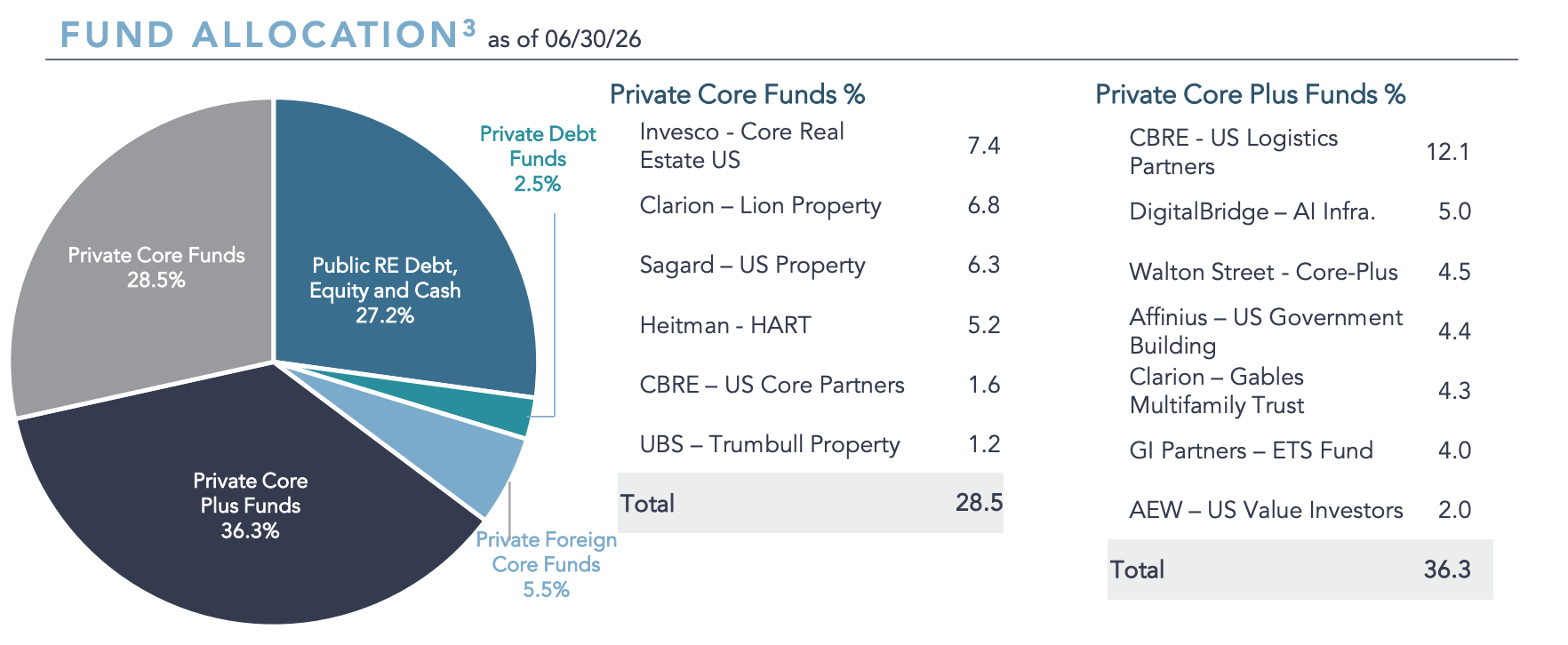
Harrison Street Real Estate Fund (VCMIX) is a $1.4 billion interval fund that invests in private and public real estate through a fund-of-funds structure:
roughly 80% in institutional private real estate vehicles,
20% in public REITs and preferred stock.
It’s managed by Harrison Street Private Wealth, a division of Harrison Street Asset Management, which sits under the Colliers International umbrella. The fund charges 0.95% on NAV, plus sub-adviser fees, plus the underlying private fund fees (0.87%) that don’t show up in the headline expense ratio (1.82%). All-in, investors are paying roughly 2.7%.
The Shrink
Four years ago, VCMIX had $3.2 billion in net assets. Today it has $1.5 billion. The 54% decline is a two-part story: capital flight and shrinking valuation.
1. Capital Flight
Let’s start with capital flight: I’ve written before that once returns slow down (or turn negative), investors run for the exits. We’re seeing this play out with VCMIX.
Speaking of capital flight, here’s another CRE case study:

Every single quarter for the past three years, investor demand to sell has overwhelmed the offer. The fill rate has been declining, and by April 2026 it dropped to 17%. Nearly 20 million shares were tendered (about 30% of the fund's outstanding shares) and roughly $380 million worth went unfilled.
Inflows haven’t dried up entirely (color me shocked): the fund still attracted $147 million during the 12 months ended 3/31/26 (in addition to $9 million in reinvestments).
2. NAV Decline
Now let’s look at the valuation side of the story: