


Happy Sunday!
I have a gem of a chart for you today.
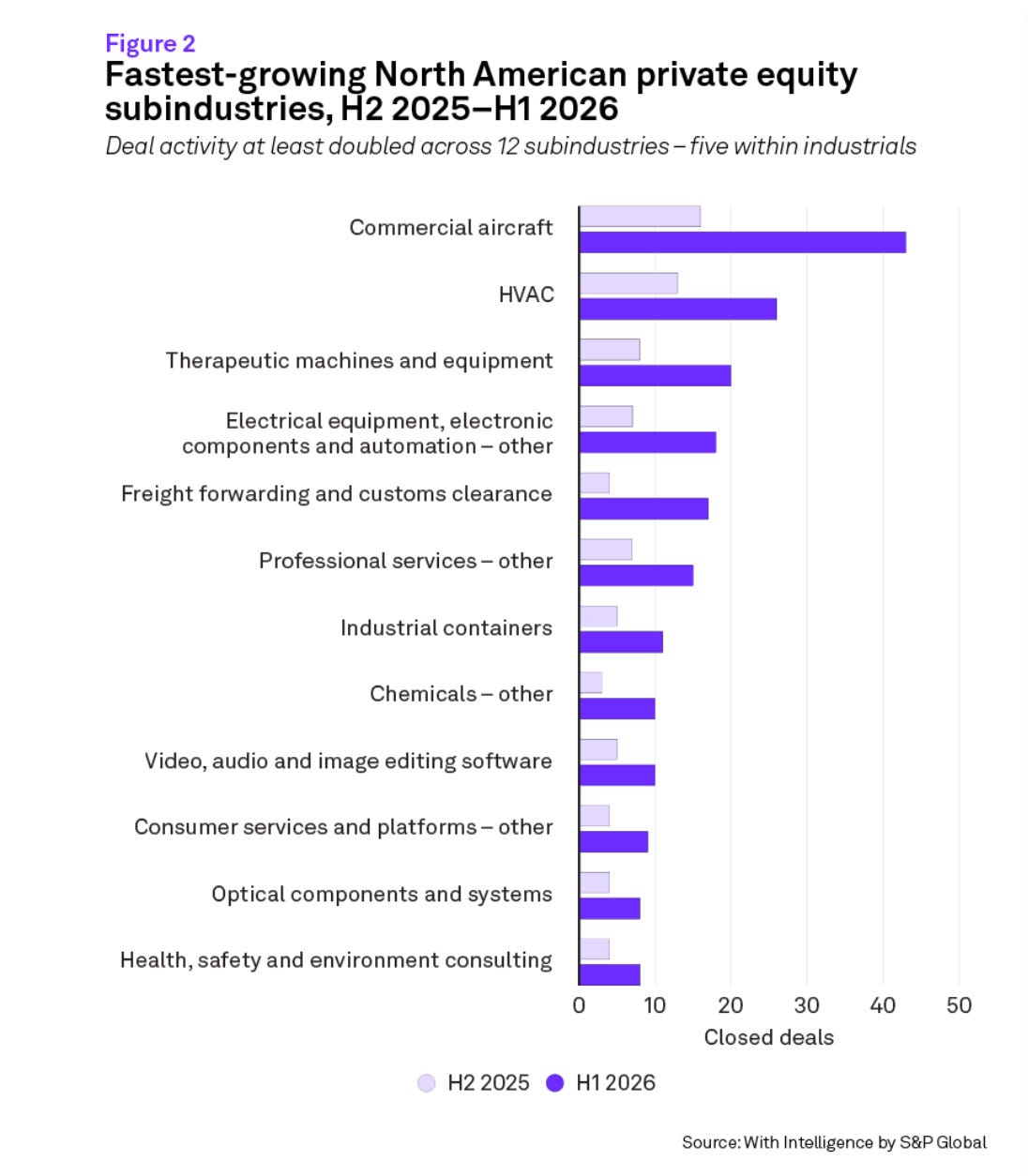
If you spend any time on X, you’ll know HVAC roll-ups are the butt of all PE-themed jokes. Laugh all you want. They’re still near the top of the PE deal leaderboard.
In this issue:
1️⃣ Regulatory: the SEC proposed opening private markets to retail investors.
2️⃣ Private Equity: 63% of portfolio companies held 4+ years. Secondaries hit a record $121B in H1.
3️⃣ Private Credit: aggressive sponsors pay more to borrow.
4️⃣ Commercial Real Estate: CRE transaction volume is recovering, pricing is up 8.6% YoY, and one awesome chart.
Accredited Insight delivers the LP’s perspective on private credit, private equity, and CRE, drawing on hundreds of deals reviewed, and thousands of conversations. Paid subscribers gain access to our database of over 40 case studies and articles on everything from evergreen funds to due diligence (the kind of analysis that tells you what the GP pitch deck left out).
1️⃣ Higher Thresholds, Wider Doors
The SEC wants to open private markets to retail investors (a familiar theme, no?)
A proposed rule titled “Enhancing Retail Exposure to Private Markets” landed at the White House Office of Management and Budget on September 1(RegInfo). It would do two things:
amend both the Investment Advisers Act and Investment Company Act to let retail investors access private markets through registered investment companies, and
expand the universe of clients who can be charged performance fees (this is the interesting part).
From the SEC: “Exposure to the full dynamism of our markets — both public and private — should not be reserved for wealthy insiders.”
And there’s an amusing bit of timing here.
Back in June, the SEC raised the qualified-client thresholds under Rule 205-3. This rule determines who can be charged performance fees by registered investment advisers.
The AUM test went from $1.1 million to $1.4 million; the net-worth test from $2.2 million to $2.7 million. Existing contracts are generally grandfathered, but new subscriptions and investments after June 29 have to meet the new numbers.
My first thought was: “Wait a second. Isn’t there a fund-of-funds workaround?”
(One can invest in a fund-of-funds without meeting the qualifications for the underlying funds, even when those underlying funds are only open to qualified clients).
Thankfully, the SEC appears to have thought of that, too. The new thresholds apply indirectly to certain fund-of-funds structures, including secondary funds. (White & Case)
Let’s play this one out a few steps. What happens when there is a flood of new money into any given asset class?
I’ll tell you what my crystal ball says 🔮 More semi-liquid (“evergreen”) vehicles. More ’40 Act structures chasing the same assets.

2️⃣ Private Equity: More Activity, Less Liquidity
274 days. (How’s that for a hook?)
That’s the median time it took to close a North American PE deal in Q2 2026, according to With Intelligence by S&P Global. (For those who struggle to divide by 30, that’s about 9 months)
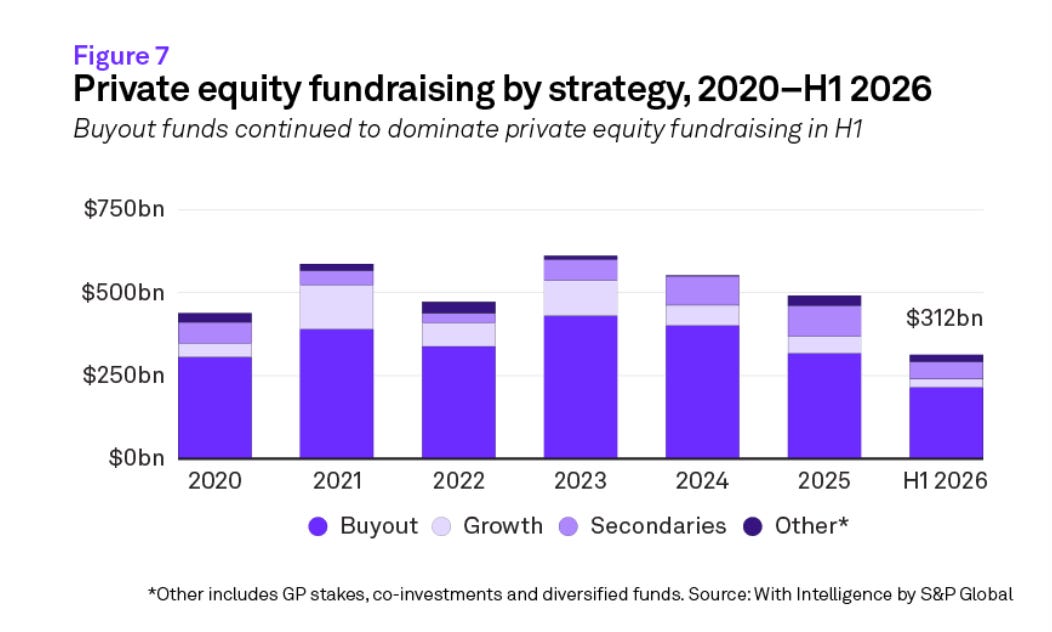
Deals are getting done (despite slower fundraising, see chart below), but the exit bottleneck is not easing up.
More than 63% of active North American portfolio companies have now been held for more than four years. Median holding periods exceed five years across every major sector except industrials, at 4.9 years.
And when exits don't happen, someone eventually has to create liquidity. Enter secondaries.

H1 secondary transaction volume reached $121 billion, according to Evercore, the strongest first half on record. Full-year estimates are now $250–270 billion. Fundraising topped $50 billion in H1, led by Coller’s $17 billion and Partners Group’s $9 billion raises.
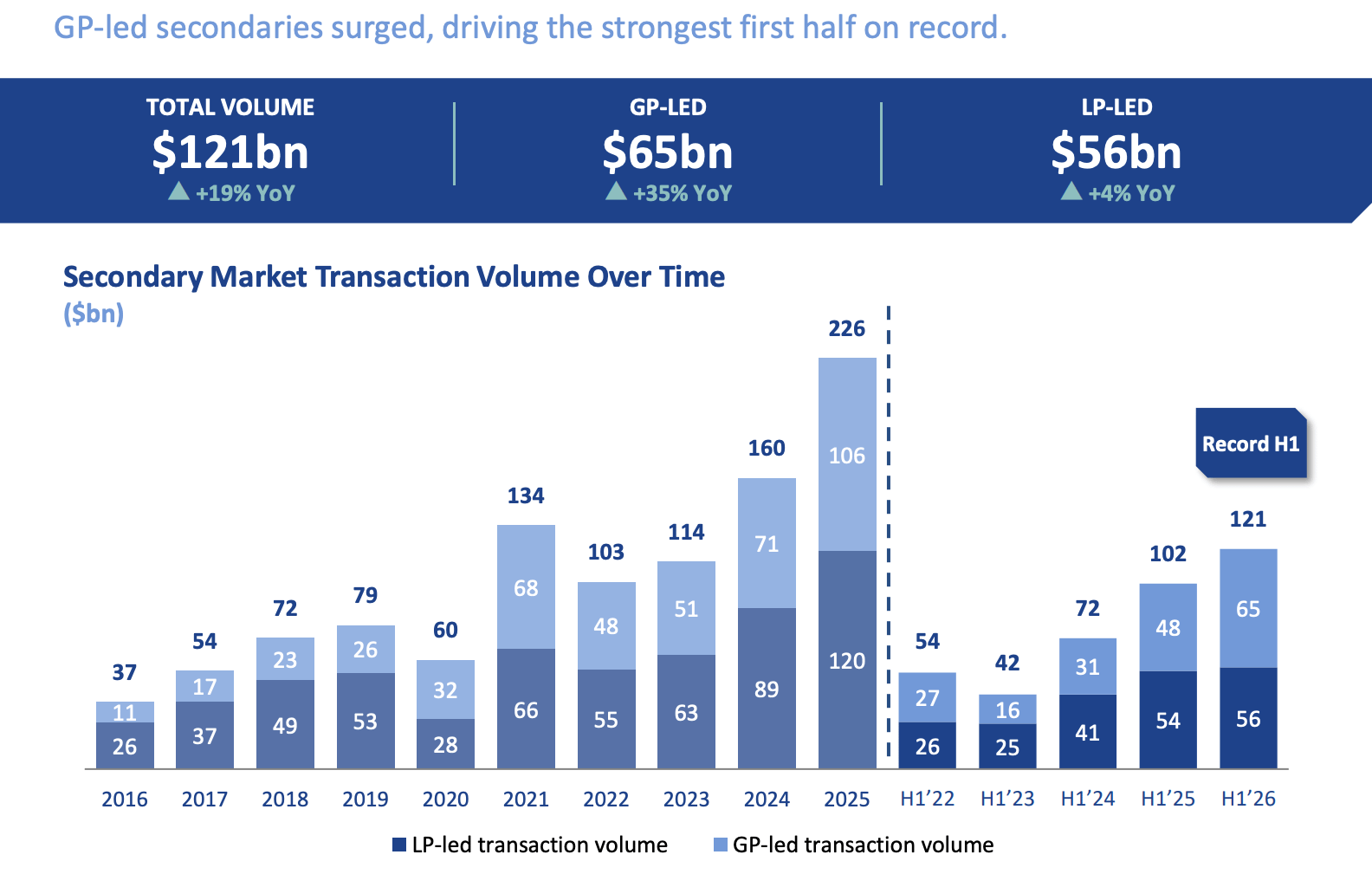
➡️ Let me connect some dots: remember how we speculated that opening the gates to allow more investors into private markets could create a surge in evergreen fund offerings?
What’s better to put into a fund than secondary stakes in stale primary funds?
(Buy them at a discount, mark them up, and generate beautiful, glorious unrealized gains..)
You really should read this, if you haven’t yet:

3️⃣ Sponsor Reputation Comes With a Yield Spread
How much more does it cost to borrow money when you’re that sponsor?
A new paper from Greg Nini at Drexel and Vincent Buccola at the University of Chicago Law School puts some data behind something credit investors have long suspected: sponsors develop reputations in the debt markets, and lenders price accordingly.
“The Sponsor Premium” uses leveraged-loan data from 2016–2025 to test whether a sponsor’s reputation for fair dealing (or the lack thereof) shows up in loan pricing. The paper comes with a naughty list of sponsors. (FT wrote about it here)
Whelp, turns out it does.
Across three different measures of sponsor reputation, portfolio companies backed by the most aggressive sponsors paid meaningfully higher yields than those backed by sponsors with more cooperative track records.
➡️ What the paper doesn’t ask is whether the more aggressive sponsors came out ahead (via more favorable outcomes in cases of default) to compensate for their higher borrowing cost.
If I had to bet, I’d say the aggressive sponsors weren’t doing it for nothin’.
4️⃣ Real Estate
Altus group published Q2 Transaction Analysis Report. Tons of good data:
Q2 transaction dollar volume rose 11.3% QoQ, with trailing-four-quarter volume up 16.3% YoY.
Pricing is recovering too: median transaction pricing rose 8.6% YoY to $131/SF, led by industrial (+13.2%). Multifamily and retail also posted solid gains, while hospitality was the only major sector with declining prices.
Larger deals are taking an increasing share of transaction value, with investors favoring larger, higher-quality assets, durable income, and markets with strong fundamentals.
But the chart that caught me off-guard? This one:
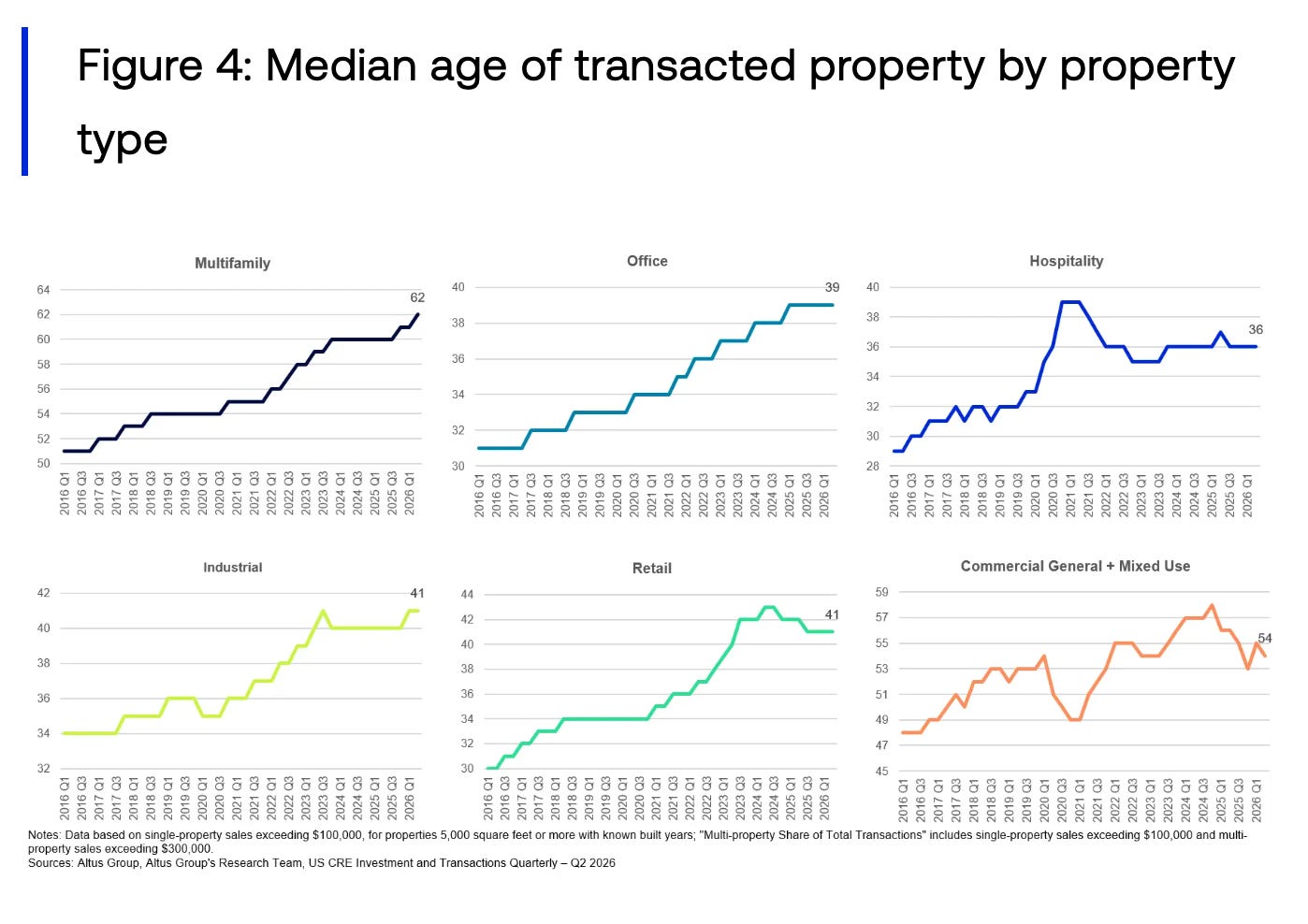
I’m speechless.
Thanks for reading! As always, if you have any suggestions, reply to this email, leave a comment, or find me on socials (unhinged me on X, slightly more prim and proper me on LinkedIn). Have a great week!
-Leyla
P.S. New here?
Here’s where you’ll find the full archive (somewhat organized):

Wouldn’t the opening of PE to 401ks’ remove support for the equity markets?
The danger is when the story is true but the price paid to own it exceeds what any realistic future can justify.