


Happy Sunday!
Every other week, we send a quick digest on what’s catching our eye in private markets.
Before we get into it, here’s the chart of the day:
Fitch’s U.S. Private Credit Default Rate hit 6.0% in April and hasn’t budged through June. But that’s not the interesting part. The interesting part is which borrowers are defaulting. Take a look at the composition:
The PCDR combines two components. The MCO universe (model-based credit opinions used to rate middle-market CLOs) is running at 4.9%. The PMR universe (privately monitored ratings used by insurers for regulatory capital) is at 9.4%.
This shows you how unevenly stress is distributed across private credit. Smaller borrowers are breaking at a much higher rate than the bigger ones.
In 2025, issuers with EBITDA of $25 million or less defaulted at a 15.8% rate, nearly four times the 4.0% rate for borrowers above $100 million (Fitch).
In this issue:
1️⃣ Private Equity: Carlyle and Bain are the last two standing in a $7B fight for Wealth Enhancement Group. Meanwhile, Ares is in talks to buy Leonard Green.
2️⃣ Private Credit: Revolut is letting Europeans into private markets for €1. UBS told clients to sell out of a Blue Owl fund it helped build.
3️⃣ Commercial Real Estate: Blackstone Mortgage is pivoting hard out of office. KKR’s CRE lender is exploring a sale. Apollo’s mortgage REIT is dissolving entirely.
Accredited Insight delivers the LP’s perspective on private credit, private equity, and CRE, drawing on hundreds of deals reviewed, and thousands of conversations. Paid subscribers gain access to our database of over 40 case studies and articles on everything from evergreen funds to due diligence (the kind of analysis that tells you what the GP pitch deck left out).
Private Equity
1. The $7B wealth manager auction
Carlyle and Bain Capital are the final two bidders for Wealth Enhancement Group at a valuation of roughly $7 billion including debt (FT reported it here). The platform oversees nearly $160 billion in client assets. If the deal closes, it would rank among the largest disclosed US private equity acquisitions of a wealth manager.
The strategic logic is pretty clear: buy the distribution, then sell more private markets products into it.
Carlyle CEO Harvey Schwartz has called the wealth channel a top growth priority; the firm's evergreen wealth strategies now hold $19 billion (up 4x from three years ago). Carlyle also owns a stake in Captrust and completed a $2.8 billion investment in MAI Capital in June.
Bain is following the similar trajectory: the firm owns roughly 29% of Carson Group, participated in Osaic's recapitalization, and took Envestnet private for $4.6 billion in 2024.
You can use your imagination to insert the related insurer in the graphic below. The ouroboros remains undefeated.
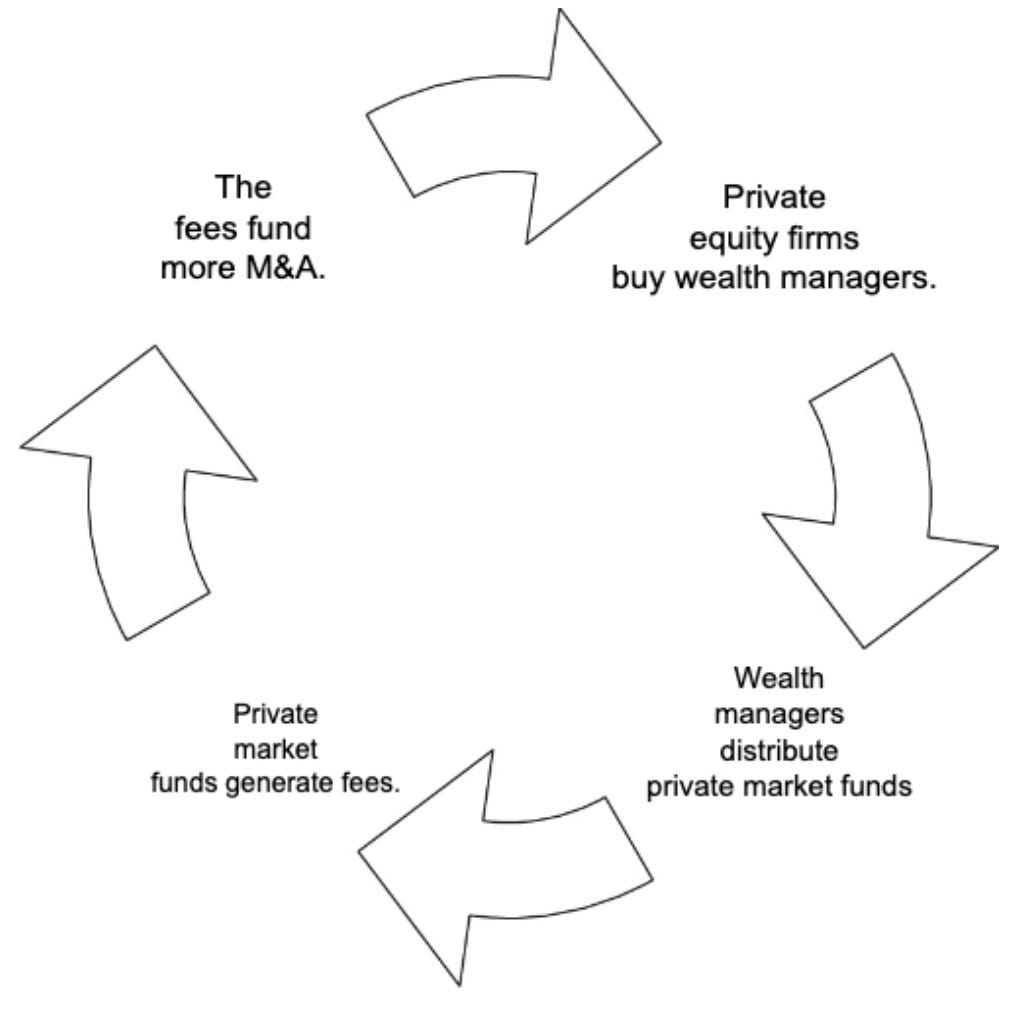
In a separate, but related story, Ares Management has held talks to acquire Leonard Green & Partners, according to the Financial Times. Ares manages roughly $644 billion in AUM, but only about 4% (~$25 billion) is in private equity. Leonard Green manages about $85 billion.
It’s asset gathering in action... (speaking of which, are we at all surprised?)

2️⃣ Private Credit
1. UBS pulled the plug on a Blue Owl fund it helped build
UBS helped trigger a wave of withdrawals from Blue Owl Technology Income (OTIC), a $3 billion direct lending fund distributed mainly through UBS wealth management, according to the Financial Times. Starting in late 2025, UBS advised over-allocated clients to diversify away from private credit, and investors started pulling large sums of money.

At least 60% of OTIC’s capital came from UBS clients, most of whom were based in Asia. That’s double what executives at another large private capital group said they’d want from any single distributor.
The unfortunate part for investors: it’s impossible to know whether a fund has this kind of concentrated capital base. Fund disclosures don’t tell you how much of the capital comes from a single distributor.
2. Revolut Offers €1 Private Credit / Equity / Infrastructure
Revolut announced it will offer European customers access to private markets funds from Apollo, Ares, Hamilton Lane, and Partners Group, with minimum investments of €1 through Revolut-managed ELTIF 2.0 feeders.
The timing is, let’s call it, interesting.
Apollo and Ares are among the managers that have restricted redemptions on other vehicles. Partners Group capped withdrawals from a major evergreen buyout fund last month (Bloomberg). And now Revolut (75 million users, no platform commissions) is opening the gates to private markets. €1 buys you a key.

Revolut emphasized that these funds are designed for investors with a “multiyear horizon” and said its in-house team screened managers for their redemption-management track records.

As Revolut’s head of wealth and trading put it: “If a fund manager was not able to show a history that they were able to manage the redemption requirements, that manager was not considered.”


3️⃣ Commercial Real Estate
Three CRE lenders, three outcomes: reposition, sell, dissolve.
If you want a snapshot of where commercial real estate lending stands in mid-2026, look at what three major mortgage REITs did this summer.
Blackstone Mortgage Trust (BXMT)
BXMT reported a net loss of $81.2 million ($0.48 per share) for Q2 2026, compared with net income of $7 million in Q2 2025. The CECL reserve (the provision for expected credit losses) jumped to $398 million, up from $284 million at year-end 2025, with asset-specific reserves on nine impaired loans.
But the story here is repositioning. BXMT received $1.2 billion in loan repayments during the quarter and reinvested $1.4 billion into new opportunities, including residential, industrial, and a new single-family homebuilder finance vertical. The company is actively rotating out of legacy office exposure into other sectors.
KKR Real Estate Finance Trust (KREF)
KREF is taking a different route. The publicly traded CRE lender is considering strategic alternatives that could include a merger, sale, or asset sale. Its board established a committee to review the options, according to Bloomberg.
KREF’s Q2 net loss nearly doubled from the prior quarter as it increased provisions for credit losses. Shares have dropped 65% over the past five years. CEO Matt Salem said the company has “made substantial progress repositioning the portfolio,” but the strategic review is open-ended with no timetable or guarantee of a transaction.
Apollo Commercial Real Estate Finance (ARI)
This is June news, but worth resurfacing. After selling its $9 billion loan portfolio to Athene in April at 99.7 cents on the dollar, ARI’s board determined that dissolution, liquidation, and winding down the business is “advisable and in the best interest of stockholders”. (Reuters)
Stay tuned, I’m working on a couple of case studies of evergreen real estate funds.
Thanks for reading! As always, if you have any suggestions, reply to this email, leave a comment, or hit me up on socials (unhinged me on X, slightly more filtered me on LinkedIn). Have a great week!
-Leyla
P.S. New here?
Here’s where you’ll find the full archive (somewhat organized):

Lots of good stuff in this one. This isn’t the first time UBS has blown up a fund because their Chief Economist / CIO in Weehawken told their network of brokers to churn and rotate into some new shiny high fee product (speaking from experience, unfortunately).
The commercial mREIT complex is having a “come to the light” moment. The “big guys”, APO, KKR, and BX are catching flak from the LPs in their private RE funds because they have these publicly traded stains (ARI, KREF, BX) on their reputation that’s killing their brands. It is hard for an allocator to feel good going up before an investment committee and pitching one of those guys managing a private RE fund when the public vehicle ticking daily on the screen has been trading below NAV for six years and has been incinerating 🔥💵🔥 capital. TPG/TRTX has been quiet, but don’t be surprised to see something happen there next.
More likely, a debt crisis or inflation surge forces a reckoning long before 2055.
https://paretoinvestor.substack.com/p/the-coming-debt-crisis